Handheld Terminal or Tap on a Phone: What Actually Works for Bristol's Market Traders in 2026
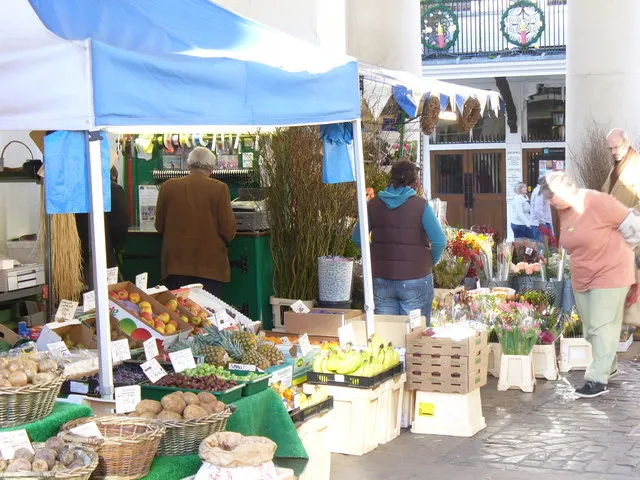
Photo: Colin Smith, CC BY-SA 2.0, via Wikimedia Commons
A Saturday morning in St Nicholas Market and a Sunday afternoon at the harbourside present the same problem in two different settings: how do you take a card payment from someone who has already decided to buy?
For most of the past decade the answer was a compact terminal with a SIM card inside it. Since contactless payments on phones became routine, a second option has become credible: a payment app on your own handset, with the customer tapping the phone itself. Both take money. They are not interchangeable, and the right answer depends on things a rate card will not tell you.
What the two options actually are
Tap-to-phone is an app on an Android handset or iPhone that uses the phone's own contactless reader. No separate hardware, no pairing, no charging a second device. You key in the amount, the customer taps, and a receipt goes out by text or email. The transaction is processed as a card-present payment, so the rate is the same as a counter terminal rather than the higher card-not-present rate.
A compact terminal is a dedicated device, typically pocket-sized, with its own SIM, its own battery and a printer on some models. It connects to your merchant account independently of your phone and can usually operate in offline mode with a floor limit when the signal drops.
The cost comparison that matters over twelve months
The pricing models differ in structure, not just level. Tap-to-phone providers tend to charge a flat percentage with no monthly fee and no minimum term, often 1.5% to 1.75%. Terminals tend to charge a lower percentage plus a fixed pence amount per transaction, plus rental or an outright purchase, plus a PCI administration fee, usually inside a 12- to 24-month agreement.
Which is cheaper depends less on turnover than on your average basket value, because the pence fee is what bites.
Take a harbourside food stall processing £1,400 a month at an average of £9, about 155 transactions. A flat 1.69% costs roughly £24. A terminal at 0.9% plus 15p costs about £13 in percentage, £23 in pence fees, £18 in rental and £5 in PCI fees: around £59. The flat rate wins comfortably.
Now take a mobile service provider invoicing £6,000 a month at an average of £60, 100 transactions. The terminal's percentage and pence fees come to about £69 plus £23 in fixed costs, roughly £92. The flat 1.69% costs £101. The terminal wins.
The rule of thumb is straightforward. Low-value, high-count trading favours flat percentage pricing. High-value, low-count trading favours percentage plus pence on a terminal.
Connectivity: the harbourside problem
Outdoor pitches generally have good mobile coverage, and for most of the year either option will work. Two Bristol-specific caveats are worth raising.
First, congestion. On a busy Sunday at the harbourside, or during Harbour Festival, the networks are carrying far more traffic than usual. A terminal with a multi-network roaming SIM will usually find a route through. A phone is locked to whichever network you happen to be on.
Second, the covered halls and arcades at St Nicholas Market. Signal inside the Exchange Hall and the glass arcade is noticeably weaker than on the surrounding streets. If your pitch is indoors under a glass roof, test both options on site before committing. A provider's coverage map is not a substitute for standing at your pitch at eleven o'clock on a Saturday.
Ask any provider two questions: does the device support offline transactions, and what floor limit applies? A terminal that queues payments and settles later can keep a queue moving through a dropped signal. Many tap-to-phone apps simply cannot.
Battery, durability and the British weather
A phone running a payment app with the screen at full brightness in daylight will drain quickly. Cold November mornings make it worse. Traders routinely carry a power bank, which is fine but is one more thing to forget.
Purpose-built terminals last a full trading day, are drop-tested and often water-resistant, and have physical buttons that work with cold or gloved hands. Touchscreens in the rain are a genuine irritation.
There is also the attention problem. When the payment device is your phone, every incoming call, notification and message interrupts a transaction at the counter.
The customer's side of the counter
A terminal reads as established and prints a receipt on request, which matters for expense claims and for older customers. A phone reads as modern and informal, and while acceptance is now high, a minority of customers still hesitate.
Digital receipts are convenient but bring data protection obligations: you are collecting a phone number or email address and must handle it lawfully. Printing nothing is cheaper and simpler, provided you have a way to issue a refund reference.
Where tap-to-phone is the better call
- You trade one or two markets a week and cannot justify a monthly fee.
- Your average transaction is under about £15.
- You have no fixed pitch, no power and no storage.
- You are running a short pop-up at Wapping Wharf with a three-month lease.
- You want to test whether card acceptance is worth it before committing to a contract.
Where a compact terminal earns its keep
- You trade five or six days a week and process a steady volume.
- Your average transaction is above roughly £25.
- You have staff sharing a device, or a pitch where the device is passed between people.
- You need printed receipts, kitchen tickets or integration with a till system.
- You trade from a van or a mobile round where the device must survive being thrown in a glovebox.
A sensible middle path
Nothing prevents you from starting with a tap-to-phone app and adding a terminal once volumes justify it. Several providers offer both under one account, which avoids the disruption of switching acquirer mid-year. Keep the app as a backup even after you buy hardware: the day a terminal battery fails at two o'clock on a Saturday is not the day to turn customers away.
A short checklist before you commit
- Test the app or terminal at your actual pitch, at your actual trading time.
- Confirm the per-transaction fee in pence, not just the percentage.
- Ask about offline mode, floor limits and what happens to a queued payment if it later declines.
- Check the contract length and the notice period.
- Confirm settlement timing, so you know when the money reaches your account.
- Check refund and chargeback handling before you need it.
For a trader starting out in Bristol in 2026, tap-to-phone is usually the right first step: low commitment, no monthly overhead, and quick to abandon if the pitch does not work. Once you are turning over several thousand pounds a month with a basket above £25, a compact terminal becomes the more economical and more reliable instrument. The mistake is buying hardware for a stall that has not yet proved itself, or clinging to a phone that fails in the rain and the crowd.